
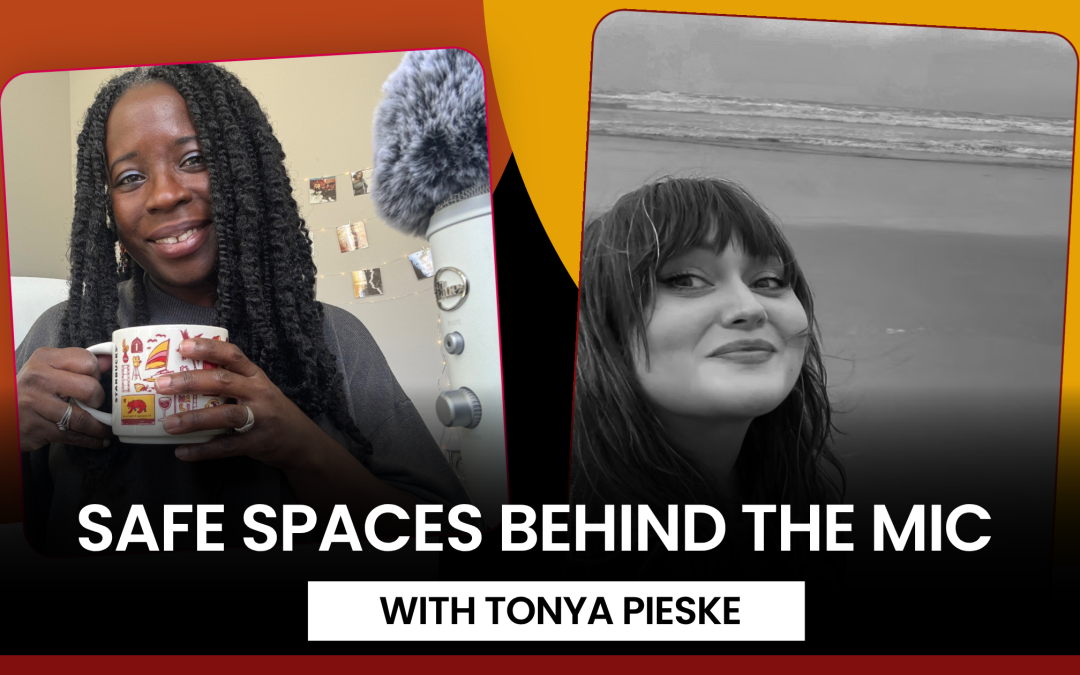
Listen to this week’s episode.
Listen On Your Favorite Podcast App | Watch on YouTube
What does it really mean to create a safe conversation on a podcast?
In a world where everyone seems to be chasing clips, downloads, and viral moments, it’s easy to forget that podcasting is still one of the most intimate forms of media we have. A voice in someone’s ear. A story shared in real time. A human being trusting another human being enough to open up.
That’s why this recent conversation with Tonya Pieske felt so important.
Tonya is doing something many podcasters overlook: she’s treating storytelling with care. Her show uses a trauma-informed process with guests so that sharing personal stories becomes a grounded, consensual, and emotionally safe experience. Instead of treating people like content, she treats them like people first.
And honestly? That’s the kind of podcasting more of us need.
Who is Tonya Pieske?

Tonya Pieske is a musician, writer, and producer based in Portland, Oregon.
With How to Tell Someone, Tonya blends her lived experience with CPTSD and her background in fostering psychological safety through her nonprofit work. She uses a trauma-informed process with each guest to ensure storytelling is safe, grounded, and consensual.
Her work on the show centers nuance and authenticity, offering a rare space for people to share the stories that shaped them.
She also brings a creative producer’s ear to the podcast, scoring episodes with original music and creating a cinematic listening experience that supports the emotional depth of each story.
Why This Conversation Matters Right Now
Podcasting has grown fast. That’s a beautiful thing.
More voices. More perspectives. More people realizing they don’t need permission to start speaking.
But with growth comes temptation.
It becomes easy to think:
- How can I get bigger guests?
- How can I get more shocking stories?
- How can I make clips that perform?
- How can I publish faster?
None of those questions are inherently wrong. But they can distract us from the better questions:
- How can I make my guests feel seen?
- How can I listen deeply?
- How can I create trust?
- How can I steward someone else’s story responsibly?
That’s where Tonya’s message lands with power.
She reminded us that podcasting isn’t just production. It’s presence.
What “Holding Space” Actually Means
“Hold space” can sound like one of those trendy phrases people throw around without meaning.
But in podcasting, it matters.
Holding space means creating an environment where someone feels emotionally safe enough to be honest.
It means:
- Not rushing them
- Not forcing vulnerability
- Not interrupting sacred moments
- Not sensationalizing pain
- Not making their story about your platform
It means you, as the host, become steady.
You don’t need to fix them. You don’t need to impress them. You don’t need to dominate the conversation.
You need to be present.
That kind of hosting is powerful because listeners can feel it.
They know when a guest feels safe.
They know when a conversation is performative.
They know when something real is happening.
The Responsibility of Interviewing Real Humans
One of the strongest points Tonya made was this:
Not everyone who has a story is a professional storyteller.
That matters.
Many guests are not media-trained. They may be sharing painful memories, life transitions, failures, grief, trauma, or vulnerable truths for the first time publicly.
That means the host carries responsibility.
If you invite someone to open up, you should be prepared to handle what comes with that.
Too many hosts ask deep questions… then emotionally disappear.
They want tears but don’t know what to do with tenderness.
They want honesty but don’t know how to respond with care.
They want the moment—but not the weight of the moment.
That’s not leadership behind the mic.
That’s extraction.
And your audience can feel the difference.
How to Create Safe Guest Conversations
If you’re interviewing guests on your podcast, here are practical ways to lead with care:
1. Give Permission, Not Pressure
Instead of assuming someone must answer everything, offer choice.
Say things like:
- “Only share what feels comfortable.”
- “We can skip that if needed.”
- “Take your time.”
- “You don’t have to answer that.”
Freedom creates better conversations than pressure ever will.
2. Send Questions in Advance
Some guests process by thinking ahead. Others calm their nervous system when they know what’s coming.
Sending themes or sample questions can reduce anxiety and increase depth.
Surprise is overrated.
Safety is underrated.
3. Warm Up Before Recording
Don’t hit record instantly like you’re starting a machine.
Talk first.
Ask how they’re doing. Laugh a little. Let the body settle.
Real conversations often begin before the official interview starts.
4. Listen for Emotion, Not Just Soundbites
Many hosts are waiting for their next question instead of listening.
Don’t just listen for facts.
Listen for:
- shifts in tone
- hesitation
- pain
- excitement
- relief
- meaning
Sometimes the real conversation is hiding in one sentence that needs a gentle follow-up.
5. Know When Not to Push
If someone gets quiet, shaky, distant, or overwhelmed, you don’t always need to “go deeper.”
Sometimes wisdom is knowing when to move on.
Not every door must be opened publicly.
Podcasting Is Not Content Churn
One phrase from this conversation stood out: content churn.
That endless machine of producing for producing’s sake.
Post more. Clip more. Publish more. React more.
But if your process strips away humanity, what are you building?
Podcasting can be strategic and soulful.
You can care about growth and care about people.
You can be professional and compassionate.
The best brands of the future won’t just be louder.
They’ll be more human.
Tonya’s One-Woman Studio Wisdom
I also loved hearing Tonya talk about building her show independently.
She produces her own audio, scores the episodes with music, edits long-form interviews, and creates cinematic soundscapes.
That’s real creative labor.
And her honesty was refreshing: it takes longer than you think.
Every podcaster needs to hear that.
Too many people assume everyone else is moving effortlessly.
They’re not.
Good podcasting takes time, intention, editing, thoughtfulness, and energy.
So if your process feels slower than expected, you’re normal.
If your first episodes take forever, you’re normal.
If you’re learning as you go, you’re normal.
Build a Podcast Around Your Capacity
Another gem from Tonya: know your capacity.
She shared that weekly podcasting doesn’t fit her life—and that’s okay.
This is freedom many creators need to hear.
You do not need to copy someone else’s cadence.
You can:
- publish seasons
- batch record
- release monthly
- take breaks
- create shorter formats
- slow down intentionally
Consistency matters, yes.
But sustainable consistency matters more.
A burnt-out podcaster with a schedule is still burnt out.
Build around your real life.
If You’re a Faith-Driven or Purpose-Led Host
For many of us, podcasting is ministry, mission, service, or calling.
That means people are not metrics.
They are souls. Stories. Lives.
When someone trusts you enough to share pain, growth, joy, or truth—you’ve been given stewardship.
Treat that with reverence.
Sometimes the most powerful thing you can do as a host is not preach louder or perform harder.
Sometimes it’s listening well.
Questions to Ask Yourself Before Your Next Interview
Before you hit record again, ask:
- Does this guest feel safe with me?
- Am I trying to get content or create connection?
- Have I prepared emotionally, not just technically?
- Can I stay present if the conversation gets real?
- Am I honoring the person, not just the episode?
Those questions can transform your show.
Final Encouragement
You don’t need the fanciest microphone to become a memorable host.
You don’t need celebrity guests.
You don’t need controversy.
You need care.
You need curiosity.
You need emotional presence.
You need integrity behind the mic.
Because long after people forget titles and thumbnails, they remember how a conversation made them feel.
And when guests feel safe, listeners feel it too.
That’s the kind of podcasting that lasts.
Reach out to Tonya
In this conversation with Tonya Pieske, we explore trauma-informed storytelling, ethical interviewing, creative DIY podcasting, and how to help guests share their stories safely and meaningfully.
If you’re building a podcast with purpose—not just noise—this episode is for you.
Listen to Tonya’s podcast, How To Tell Someone, and join her over on Substack: https://www.howtotellsomeone.com/
——–
Need extra podcast coaching support? I can help! Also, my community is open now at the Christian Women Podcasters Network.

- 132. If I Had to Start My Podcast Over, Here’s What I’d Do - September 19, 2026
- 131. How Lindsay McMahon Turned a Podcast Into a Global Business - September 13, 2026
- 129. The Inner Work Behind a Powerful Voice with Camilla Calberg - August 25, 2026